Be a rose which gives fragrance even to those who crushes it.
Friends are like flowers, They always bloom in color.
Pick a flower, hold your breath and drift away.
Tens of thousands of tourists have flocked to catch a glimpse of these spectacular quilted farmlands in all their technicolor glory. Many flower-gazers are so excited by the views that they have parked caravans along the bulb fields in a bid to soak up every last hue.
The vibrant blues, reds, pinks and yellows sprawl as far as the eye can see in Lisse, western Netherlands, where farmers hope to make huge profits selling them to florists and supermarkets around the world.
The tulip season begins in March and lasts until August with several shows held across the country, but the flowers are undoubtedly at their most spectacular at this time of year. More than three billion tulips are grown each year and two-thirds of the vibrant blooms are exported, mostly to the U.S. and Germany.
LIFE IS NOT A BED OF ROSES BUT ROSES MAKES A LIFE SWEET AND COMFORTABLE.
Peacock Flower (Caesalpinia Pulcherrima)
An excellent bush with lovely miniature, they are flowers that bloom in summer. Also known as the Bird of Paradise. The text book advises that seeds be soaked in warm water to soften its tough coat, but when I planted them straight, they all sprouted. Great decorative shrubs for every home-garden. Easy to grow. Ask for a few seeds from the neighbours, they will give it free as the pods grow luxuriously. Plant only the brown mature seeds.
Clitoria Ternatea
(Mussel Shell Creeper)
Clitorians are also known as butterfly-pea, known for their open pea-flower of cobalt blue which is quite a rare colour in the botanical world. This fast-growing creeper blooms throughout the warm weather and can be grown from seeds.
Silk Cotton Tree (Bombax Ceibe)
It remains green, and leafy throughout the year, but as winter approaches, it will shed leaves, and bloom with bright red flowers that attract several types of insects and nectar seeking birds. The bud, after a couple of weeks, bursts open with its silken-thready filaments with seeds at their end. The wind carries away light silken threads all around, where, in shade and moist soil, the seeds sprout to start the pleasure regeneration cycle once more. This silk is also used to stuff pillows.
Cassia Fistula
These small trees will grow anywhere in any soil. Do plant it. The flowers are like golden candles. Passers-by usually stop to admire the bloom, which brings a smile to every face.
Pink Rose
The rose is considered the queen of flowers for its splendid colour variations, delicate petals and pleasant fragrance. Over 250 varieties of rose flowers are found in the wild . The third, slightly pale yellow variety grows in China. These three were crossed and recrossed to produce different colours, hues, and sizes. Over a thousand and five hundred hybrids are known. Remember, the rose likes to grow alone and dislikes soggy soil.
Celosia Argentea
Celosia Argentea, cockscomb in general terminology, is also known as the Chinese wool flower. It thrives well in hot and humid climate. Seeds are readily available
Chinese Trumpet Creeper
This handsome creeper also known as Golden Shower will cling to almost any surface by means of aerial roots and is a useful fast cover. Its trumpet-like flowers are lovely. A must for every home.
Bougainvillea
Bougainvillea, otherwise known as paper flower, come from Australia. Plant and forget them because they love to grow by themselves, asking just for a sip of water and a pinch of manure.
A delightful bush that loves the soil grows profusely anywhere, but hates shade. Bougainvilleas are popular ornamental plants in most areas with warm climates, including Indonesia, India, Taiwan, Zimbabwe, Vietnam, Malaysia, the Philippines, Australia, the Mediterranean region, the Caribbean, Mexico, Pakistan, Panama, South Africa, the southern United States and Hawaii.
Numerous cultivars and hybrids have been selected, including nearly thornless shrubs. Some Bougainvillea cultivars are sterile, and are propagated from cuttings.
Hollyhocks (Alcea Rosea)
Hollyhocks, or Alcea Rosea, are the darlings of every park, home-garden and courtyard where flowers are grown in winter for colour and decor. This plant may grow to six feet and lasts longer than any winter annual. A must for every park, can be grown even in pots.
Flowers are a blessing of nature. Their beautiful colors and pleasant scent makes this world a heaven. There are variety of flowers, some of which are mentioned here:
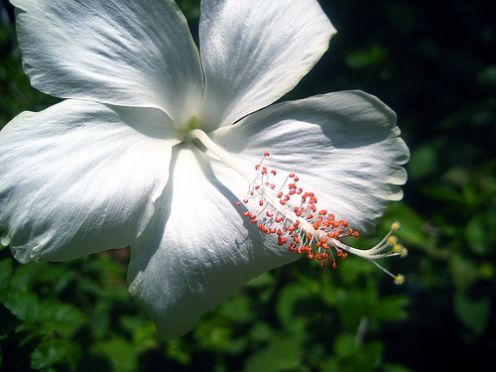
Hibiscus
Hibiscus is the Chinese rose and has over twenty shades. Blooms almost all year round. Any garden seems dull without this excellent bush that will take root even when a branch is planted in the ground. It is the national flower of Hawaii.

Native to Africa, Freesia is a genus of 14-16 species of flowering plants in the Iris family. Freesias are strongly scented so they make a nice addition to any area. They have five to 10 single or double flowers. Stems are usually 10 to 18 inches long with little or no foliage. The bell-shaped freesia blooms up to seven days and comes in white, golden yellow, orange, red, pink, mauve, lavender, purple and bicolors. They are herbaceous plants which grow from a corm 1-2.5 cm diameter, which sends up a tuft of narrow leaves 10-30 cm long, and a sparsely branched stem 10-40 cm tall bearing a few leaves and a loose one-sided spike of fragrant narrowly funnel-shaped flowers.
Himalayan Whorlflower is a beautiful evergreen perennial herb from the Himalayas. It adds charm to the Valley of Flowers, where it grows in abundance. The plant has flowering stems up to 1 m tall. Has linear, glossy, dark green leaves with sharp spines along the leaf margins. Bears tiered whorls of white flowers that turn pale pink and then rosy red after fertilisation. Himalayan Whorlflower is found in the Himalayas, from Kashmir to Bhutan, at altitudes of 3000-4000 m. Flowering: June-September

Butt Mogra, a slow growing Jasmine but grandest of them all. This tall growing shrub has Gardenia type flowers as large as carnations. Due to certain phenomena the older plants seem to be even more fascinating in providing flowers of different shapes and sizes on the same plant at the same time.
Butt Mogra, a slow growing Jasmine but grandest of them all. This tall growing shrub has Gardenia type flowers as large as carnations. Due to certain phenomena the older plants seem to be even more fascinating in providing flowers of different shapes and sizes on the same plant at the same time. This plant loves partial shade and very well drained and moist soil. The flowers do not seem to drop off and in most cases will dry right on the plant. this is the plant used to flavor the jasmine tea and making perfumes. Perfect houseplant, takes both sun or shade, Butt mogra is a beautiful fragrant everbloomer for your home and garden.
Red Ginger Lily is a very uncommon ginger with beautiful bright red flowers. In form, the flowers look similar to those of Butterfly Ginger Lily. Flowers appear in spikes. It is found in NE India, particularly Manipur.
Medicinal uses: Decoction of rhizomes is given in bronchitis and stomach complaints.
4=Wild Jasmine is a small climbing shrub. Stem is smooth but branchlets minutely pubescent. Oppositely arranged, simple leaves are very variable even on the same plant. Leaves are 1-3 cm long, 7-20 mm broad, elliptic-ovate. The smooth leaves are acute, base obtuse or almost rounded. One inch across white, star-like flowers are exquisitely fragrant. The flowers are either solitary or more usually in threes. Petals 7 or 8, but can be more in number. Petals are linear, obtuse, very acute. Carpels two usually well developed. Flowering: June–August.